Monday, September 18, 2017

A Delicious Menu for a Memorable Teej Party

Hariyali Teej is an Indian festival which is celebrated with a lot enthusiasm and gusto by women across the Northern states of Rajasthan, Uttar Pradesh, Madhya Pradesh and Bihar. Hariyali Teej falls in the Shravana month, usually two days before Nag Pachami.  The festival is dedicated to Lord Shiva and Goddess Parvati. The Shravana month, also known as Sawan, is considered to be a holy month for observing fasts and worshiping Lord Shiva and Goddess Parvati. This year, the festival will be celebrated on 26th July, 2017.

Hariyali Teej symbolizes the reunion of Lord Shiva and Goddess Parvati which is why it is regarded auspicious for married women.  They worship Goddess Parvati and pray for marital bliss. On the festive day, they visit their parent's home, and deck up beautifully in green Sari and with green bangles which is the significant colour of the festival. 

After performing puja at home, a group of women usually get together to enjoy the festivities by preparing swings (symbolic to the festival), singing Teej songs and snacking on some delicious food. Well, a celebration like this definitely calls for a sumptuous feast. If you are planning to throw a Teej party for your friends and family or your daughter or for your daughter-in-law, here's a fully-planned menu to avoid all the fuss.

Drinks

For drinks, try this refreshing and aromatic Jawant Sharbat by Chef Niru Gupta. It is made with beautiful hibiscus flowers and is definitely an impressive drink. You can even keep a sweet and tangy Pineapple Panna by Chef Rajdeep Kapoor for those who would not like to experiment.

Snacks

It's the perfect weather to enjoy an outdoor tea party with some crispy, crunchy delights. Try this interesting version of our favourite tea-time snack - Mushroom Samosa by Chef Niru Gupta. The Rajasthani Mirchi Vada is a popular street snack from Jodhpur, recreate the magic at home with this easy recipe by Chef Niru Gupta.These small bites are perfect to indulge in without ruining your appetite. For those who are calorie-conscious, these baked bite wrapped in crunchy sesame seeds is the best bet - Til-E-Paneer by Chef Niru Gupta. If you're an experimental cook and you quests are adventurous foodies, these melt-in-mouth Rajma Kebabs are a must on your snack menu.

Main Course

For mains, go for the traditional dishes like the Dal-Baati which is perfect for this nippy weather. Hot, simmering dalserved with ghee-laden baatis is the best combination. Try these absolutely delicious Stuffed Baatis by Chef Sujata Natraj filled with paneer and spices. Along with this, serve a tangy and spicy Palak Mirchi Kadhi by Chef Kunal Kapoor along with a nutty Sesame Seed Pulao by Chef Marut Sikka.

Desserts

For a sweet, sweet ending stick to the classic dessert of the festival - Ghewar but show off your culinary skills by making it at home. This version with a rich topping of malai and nuts by Chef Ashish Deva from Jaisalmer Marriott Resort will win over all your guests. To add a fun element, try these dainty Gulkand Cupcakes by Chef Swasti Aggarwal.

With our simple recipes and this fantastic menu, you can be a part of your Teej festivities and don't have to worry about a thing.

Sunday, August 13, 2017

Green Crabs Are Officially Delicious


Kick over a rock or a chunk of turf along the coast of Maine and chances are a horde of invasive green crabs will scurry out. Since their accidental introduction to the North American coast by European ships in the early 1800s, green crabs have become among the most common creatures in the region. Commercial crabbers and lobster fishermen motor past millions of them every day because the credit card-sized crabs—though perfectly edible—are too small to be worth manually shucking.

A new processing technique explored in a scientific paper by researchers from the University of Maine could change that. By experimenting with a mechanical means of extracting meat from green crabs, they hope to create a market for the ecologically disruptive animals.

As a food scientist who specializes in reducing waste of seafood, researcher Denise Skonberg had long been aware of the Paoli One Step Deboner, a machine that resembles a meat grinder the size of a truck transmission. After workers strip off the chicken meat, carcasses are put in the machine, deboned, and emerge as a paste-like meat product. The machine can also be used for green crabs.

If green crab paste becomes commercially successful, it could become a key part of coastal habitat restorations.

"The cost of fuel would prevent it from being a specifically targeted catch," says Skonberg, one of the paper's three authors. Since fishermen are already on the water for high-value species such as lobsters, they could add the 7.5-centimeter-wide green crabs to their catch. "Instead of killing the crabs or throwing them overboard, they can have a bin for crabs and a bin for lobsters."

A commercial fishery is unlikely to ever completely eradicate green crabs, but reducing their numbers would still benefit ecosystems and humans.

Green crabs alter their habitat in dramatic ways. Their activity, for example, disrupts and kills beds of eelgrass, which serve as essential protective cover for many species of juvenile fish. But most distressing to Mainers, the crabs eat clams in large quantities and compete with young lobsters for food.

The green crab problem has gradually worsened in northern waters. Historically, cold winters limited the population. A New Brunswick study in the 1950s and '60s showed that as temperatures declined, so did the green crab populations. Monitoring traps went from an average of 343 crabs a day in 1956 to 7.5 a day in 1960. But with ocean temperatures warming, crab numbers have risen dramatically.

New introductions of green crabs in ballast water from northern Europe have recently provided cold-tolerant genes to the invasive population. This has probably contributed to the recent population explosion in the cold waters of Maine and Eastern Canada.

As the crab populations expand, perhaps human palates will too.

"Compared to other kinds of crabs, the flavor is sweeter," Skonberg says. The texture of processed meat, however, isn't quite what people expect from crab. "It's more like a puree.

So there are challenges in using the finished product as food, but it is somewhat familiar to North Americans. Green crab puree is a variation of the centuries-old Asian seafood paste surimi. In the 1960s, Japanese researchers applied the principles of surimi production to cheap Alaskan pollock, creating imitation crab legs found in most North American grocery stores today.

Skonberg and her coauthors decided to use the green crab paste in a dish where the fibrous texture of normal crabmeat would not be missed: empanadas. And because this is science rather than just having fun in the kitchen, they conducted organized taste tests and collected data. Sixty-three percent of respondents said that they would "probably" or "definitely" buy crabmeat empanadas if they were available locally.

"It's a realistic idea," says Christina DeWitt, director of the Seafood Lab at Oregon State University, noting that the seafood industry uses all kinds of minced seafood in a variety of products. "I have never thought about surimi for crab, but it's possible. We typically take low-value fish and convert it into surimi that is imitation crab, but this is already a crab."

Thursday, July 20, 2017

Five delicious French desserts that only require a few ingredients

There are French desserts in the vicinity of which you dare not breathe, lest they crumble, deflate, or melt with your disturbance. Quelle horreur! These are the soufflés (all that swell), the puff pastry (all those layers), the petits fours (all the microscopic artistry), the yule logs (all that fake dirt). And please don't get my started on the precious macarons.

Pastry cream, piping bags, Paris Brest, pageantry!

On an ambitious day, I may, er, essaie to make an éclair or a pain au chocolat at home, but throughout that entire journey, I'll know in my heart of hearts that I should have saved time and tears and visited the pâtissiers at the pâtisserie.

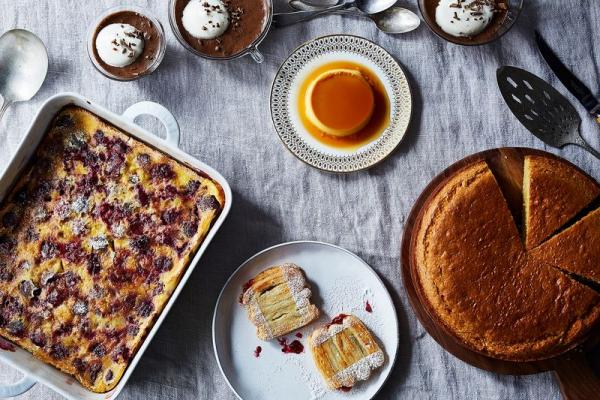
These five desserts are not that kind, however. They're low-maintenance (relatively speaking), forgiving, et très facile. They're homey enough to, well, make at home — and make well at home — without taking up your entire afternoon, but they're still delicious enough to impress a guest or two after a soirée.

And — here's the kicker! — they all have just five ingredients, none of which are obscure or particular fancy. Hip hip! (Okay, that's un petite fib — some have six! So sue me.)

Sans further adieu, the sweet stuff. Ranked from easy to difficult and from quick to time-consuming. Find more recipe details below.

1. THE DESTINY OF YOUR PRECIOUS SUMMER FRUITS

Clafoutis = Fruit + Eggs + Flour + Sugar + Milk

From David Lebovitz, a marshal of French desserts, comes the simplest and fastest treat on this list: clafoutis, a puffed, pancake-y fruit dessert that I might call the French cousin of the Dutch baby were I to get all EU in this article.

All you need is a blender, or a powerful whisking arm, and 45 minutes. (You don't even need a cherry pitter if you've got a bottle and a straw — or if don't mind giving your dentist anxiety.)

Blend some flour, sugar, eggs, and milk until smooth, adding vanilla bean, almond or vanilla extract, or even liqueur like kirsch or amaretto as you see fit, then pour this batter over the cherries that you've scattered in the baking dish. Set a timer for 45 minutes.

As the clafoutis bakes, the batter puffs, subsuming the cherries; it says eggy and spongey in the middle while crisping and browning along the perimeter — and that textural dichotomy certainly means you must try at least one scoop from each area.

2. THE I-NEED-CAKE-NOW CAKE

Yogurt Cake = Eggs + Yogurt + Flour + Sugar + Oil

You don't even have to cream butter and sugar — or get out the measuring cups. If you use two 4-ounce tubs of yogurt, you can use those as your guide: Add 1 1/2 tubs of sugar, 4 tubs of flour, and 1 scant tub of vegetable oil.

This cake may be foolproof, but you will want to be careful not to over-mix the batter and to monitor the cake so it's neither over- nor under-baked. And if you're looking to give your cake some flare, try modifying it as you would pound cake. Or take a cue from Dorie Greenspan, who perfumes her sugar with lemon zest before mixing it into the other ingredients.

3. THE SHATTERINGLY CRISP SANDWICH COOKIE

Pailes = Puff Pastry + Eggs + Sugar + Flour + Jam

You've seen a palmier (call it an elephant ear, if you wish). But get a bit more involved with your folding, slicing, and positioning, and you can transform that same sheet of puff pastry (store-bought, bien sûr!) into the fancy-looking sandwich cookies known as pailles, meaning "straws."

You'll roll the puff pastry into a big square, then fold it in half two times, being sure to brush it with egg wash and sprinkle it with sugar between each fold for maximum caramelization. Next, you'll slice the folded pastry into thin fingers, which you'll then reunite into groups of three. Before putting the cookies in the oven, you'll cover them with a sheet of parchment paper and an upside-down cooling rack so that they bake more up than out. Halfway through baking, you'll remove those weights, press the cookies with a spatula, and flip them. Sounds like a lot of work — but it's more assembly than anything else.

Once the cookies are cool, you'll sandwich them with jam (or, bonne idée, lemon curd) and dust them with confectioners' sugar. And finally, gather your napkins. "The pastries are very brittle, and the sweet jam is very soft, so that when you bite into them, there's always a little ooze and lot of crackle and crumbs," writes Dorie Greenspan in Baking Chez Moi. A welcome mess!

4. FLAVOR OF CHOCOLATE BAR, FLUFF OF MARSHMALLOW

Chocolate Mousse = Chocolate + Eggs + Sugar + Cream

No funny business here: This chocolate mousse is simply melted chocolate that's thickened with egg yolks and lightened with whipped egg whites. Like your favorite chocolate bar frolicked among the clouds.

If you're comfortable whipping egg whites and incorporating them gently, as to not deflate that hard-earned air, then the recipe — which is from Dorie Greenspan's Around My French Table and has been published on NPR and in Bon Appétit — will be a cinch. Perhaps that's because Dorie, when she implored her friend Martine for the ingredients and instructions of her favorite mousse, was handed a Nestlé chocolate bar: All of the information was on the back.

5. CARAMELODY

Crème Caramel = Sugar + Milk + Cream + Eggs + Vanilla Extract

Okay, you daredevils: This one's for you. It's the most challenging dessert in our quintet because you have to make caramel and custard and endure a 12-hour chilling period. And once that's all squared away, you must then invert the crèmes and cross your fingers that they slide out of the ramekins in good shape. If that doesn't make your heart rate increase, might I suggest bungee jumping?

But the results are worth it: a quivering pudding with a waterfall of caramel that sweetens every bite. To take the recipe a step further, infuse your cream — with crushed cardamom pods, orange zest, chopped coffee beans, Earl Grey tea leaves, or fresh herbs — before you begin.